
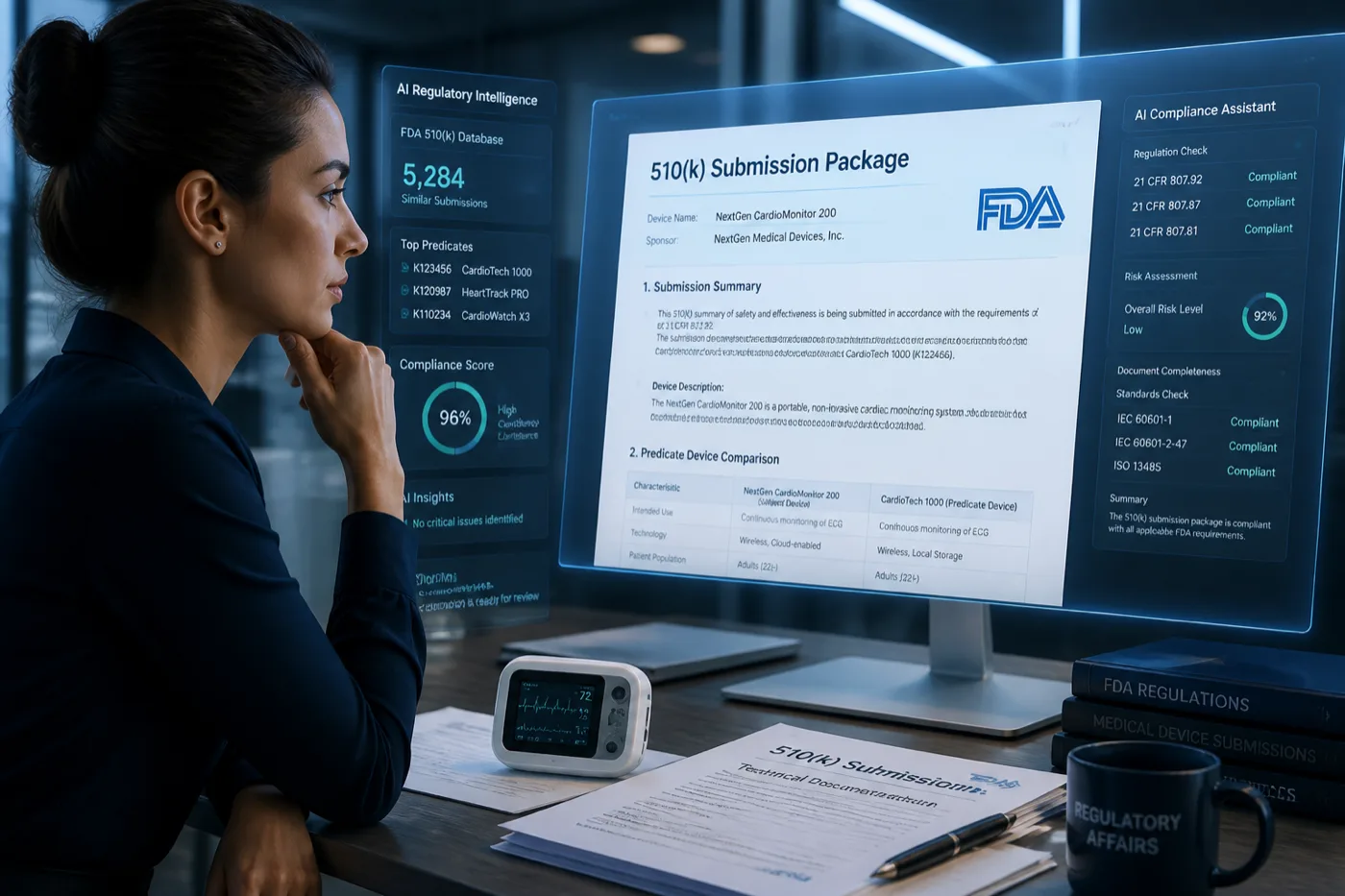

Register your medical device with FDA
- with AI as your copilot

From regulatory assessment and risk classification to a complete 510(k) submission in eSTAR. 40 live hours using a real case study, with AI applied at every stage - always under human validation.

  • 40h live, 6 modules, 10 sessions
  • Leave with an end-to-end 510(k) submission assembled
  • AI applied to Regulatory Affairs in every module
Secure my place
FDA Medical Device Registration with AI Course
40 live hours, with applied AI
Why this course?

Brazil's only course teaching AI applied to FDA registration - with human validation.

AI multiplies productivity in Regulatory Affairs: classification research, dossier writing, gap analysis and checklists. Used without judgement, however, its errors are costly. This course teaches you to accelerate safely - and you leave with a real 510(k) submission assembled from end to end.

  • 40 hourslive and synchronous
  • 6 modules10 sessions of 4h
  • Cohorts of 25real breakout-room practice
Target audience

Who is this course for?

Five profiles gaining technical independence in the US market - and speed with AI.

  1. RA and QA professionals

    Who need to master the FDA pathway to accelerate their products' access to the US market.

  2. Domestic and overseas manufacturers

    Planning to sell in the USA and seeking to anticipate timelines, costs and market entry strategy.

  3. Importers, distributors and US Agents

    Responsible for regulatory obligations before FDA.

  4. Clinical, product and quality engineers

    Involved in design, submission and post-market activities.

  5. Regulatory consultants

    Seeking to structure an FDA-focused service offering - with AI increasing productivity.

Learning outcomes

What you will master.

By the end of the course, you will master the complete FDA registration lifecycle - and know where AI accelerates each stage.

#CompetencyWhat you deliver
01Regulatory assessment and classificationClassify any device by risk class, with the correct product code and regulation number.
02Market pathwaySelect 510(k), De Novo, PMA, HDE or an exemption - and justify the decision.
03User fee savingsReduce MDUFA user fees through Small Business Determination, including as an overseas manufacturer.
04Dossier and eSTARAssemble the technical dossier and eSTAR submission, from the predicate to the technological comparison.
05QMSR and design controlsConnect QMSR and design controls (DHF/DMR/DHR) to submission content.
06UDI and GUDIDCompose the UDI and register the DI in GUDID - with a live screen demonstration.
07Post-marketPlan labelling, MDR, recalls and post-market surveillance.
08Applied AIAccelerate each of these tasks with AI - verifying every output against official sources.
The journey in 6 modules

From regulatory classification to 510(k) submission.

The modules build on a single case study (Class II device) through to a complete 510(k) submission. Each includes a practical AI application within a real regulatory workflow.

  1. FDA system and risk classification

    Understand the FDA structure (CDRH) and classify your device by class, product code and regulation number.

    • Deliverable: regulatory assessment and classification of the case study device
    • AI: classification screening and product code research, confirmed in the FDA Classification Database
  2. Market pathways and user fees

    Choose between 510(k), De Novo, PMA, HDE and exemptions - and reduce costs through Small Business Determination.

    • Deliverable: pathway decision matrix + user fee estimate (standard × small business)
    • AI: predicate research and pathway comparison
  3. Technical dossier and eSTAR

    Structure the submission: predicate comparison, bench testing, biocompatibility and assembly in eSTAR.

    • Deliverable: dossier structure and eSTAR draft
    • AI: drafting descriptive sections and a completeness checklist
  4. QMSR and design controls

    Connect the quality system (QMSR/ISO 13485) and DHF/DMR/DHR to submission evidence.

    • Deliverable: design controls map linked to the dossier
    • AI: quality gap analysis and evidence organisation
  5. Labelling, UDI/GUDID and post-market

    Meet labelling requirements, compose the UDI and register the DI in GUDID - with a live screen demonstration - and plan MDR and recalls.

    • Deliverable: UDI composition and simulated GUDID registration
    • AI: GUDID attribute checklist and 510(k) × label consistency
  6. Final workshop: end-to-end 510(k) submission

    Assemble the case study's complete submission and defend it before a panel.

    • Deliverable: a complete 510(k) submission, presented and defended
    • AI: a copilot for final assembly and simulated responses to deficiency letters
What sets it apart

AI applied to Regulatory Affairs.

Responsible acceleration. AI does not replace the RA professional - it multiplies their capacity. You learn the safeguards that keep it safe in regulatory work.

Where AI accelerates work

Research and screening (classification, product codes, predicate candidates); assisted writing (dossiers, technological comparisons, responses to deficiency letters); analysis (QMSR × ISO 13485 gap analysis, eSTAR and GUDID checklists); and technical Portuguese-English translation for overseas manufacturers.

Safeguards you learn

Mandatory verification against official sources (eCFR, fda.gov); confidentiality and LGPD (sensitive data must never be entered into public AI tools); human-in-the-loop (regulatory decisions always remain with the professional); traceability of every output to its legal basis.

Copilot, not pilot

AI drafts, suggests and checks. Regulatory decisions - market pathway, classification and final submission content - always remain with the professional. You leave the course knowing how to use AI as an experienced copilot, with technical independence.

High impact

Two topics that change your project's cost and timeline.

Professional reviewing FDA user fee reductions for small businesses

Small Business Determination (SBD)

Your company may pay considerably less to FDA. CDRH's SBD programme reduces or waives MDUFA user fees for smaller businesses - including overseas manufacturers. You learn the eligibility thresholds, the CDRH Portal procedure and the specific pathway for Brazilian manufacturers.

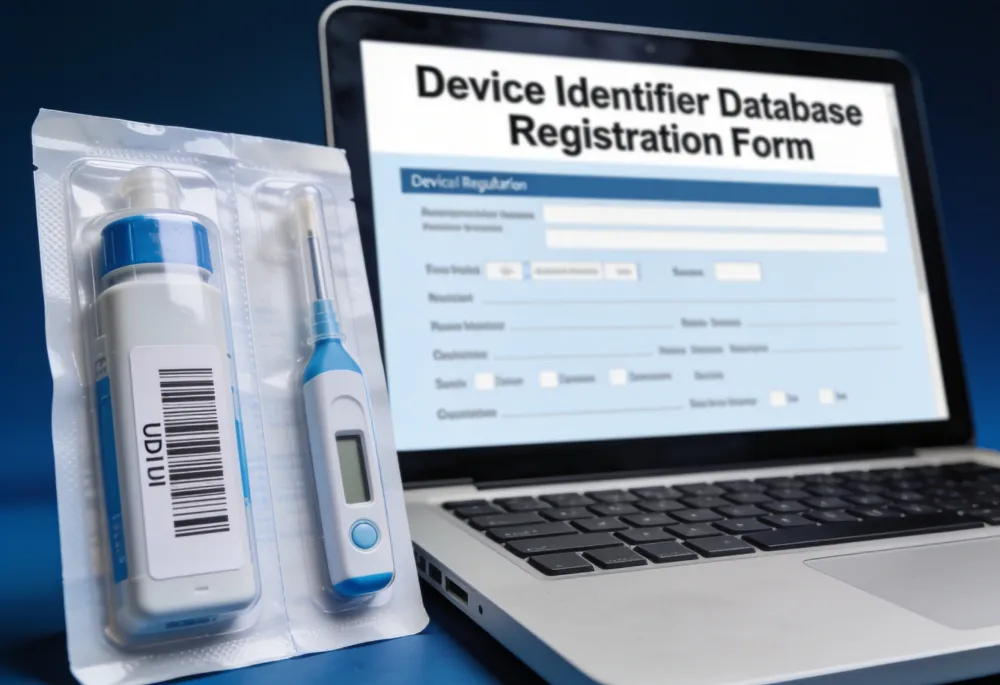
Medical device with a UDI label and GUDID registration

UDI and GUDID registration

From concept to screen: see the complete DI registration workflow in GUDID live - account, attributes, publication and common errors - and learn to compose the UDI (DI + PI) under 21 CFR Part 801 and Part 830.

How we learn

Live, practical and based on a real case.

No endless lectures. Each session alternates short conceptual blocks, live screen demonstrations and guided practice - with pre-work and post-work to consolidate learning.

40% practical work in every session

At least 40% of the time spent on practical activity, with interaction every 15-20 minutes: a question, poll or mini-case. Breakout rooms with written instructions, a defined time and a deliverable.

Live screen demonstrations

Classification Database, eSTAR and GUDID registration demonstrated in real time - see the official tool working, with the instructor navigating each field.

A single case study

One device (Class II) developed module by module through to a complete 510(k) submission. Leave the course with a real deliverable - more than a classroom exercise.

Certification and instructors

A 40-hour HSC Academy certificate - delivered by senior RA consultants.

The course is delivered by HSC Global Group's senior Regulatory Affairs consultants, with medical device regulatory expertise and live-course experience. All content is produced with AI support and validated by an RA/RTP specialist before each cohort - the same verification discipline we teach in class.

  • 40 hoursof training
  • HSC Academyissues the certificate
  • On completionsubject to attendance and achievement requirements
FAQ

Frequently asked questions

Your questions about the FDA Medical Device Registration with AI course answered.

Next cohort

Your entry into the US market
starts with a conversation.

Cohorts are limited to 25 participants to ensure real breakout-room practice. Leave the course with a 510(k) submission assembled and defended before a panel - with AI working in your favour.

40hlive, synchronous
25places per cohort
510(k)a real submission assembled
I want a place in the next cohort
Without a method With the course + AI
Classification and pathway by trial and error A method using product codes and regulation numbers
A 510(k) dossier assembled without guidance An end-to-end 510(k) assembled in eSTAR
AI used without judgement, risking errors AI with safeguards and official-source verification
Dependence on costly external consultancy Technical independence in your submission

This is an educational course. Regulatory decisions for a specific product require case-by-case analysis by a specialist. The certificate attests to participation and achievement; it is not a regulatory opinion.

Find your FDA profile

Answer 5 quick questions and we will show you how the FDA Registration with AI course fits your career.

1 FDA experience
2 Area of work
3 Objective
4 ANVISA
5 Current situation
Result
